Investigative longread · Document #002
The Link That Gave Them Away
How Alabuga Polytech's own website exposed a Geran recruitment funnel behind an education-facing facade.
The public site sold education. The campaign pages sold Geran work.
Alabuga Polytech showed the public an education-facing facade. Behind direct campaign links on the same domain, it advertised a Geran/UAV military recruitment pathway for students. This is concealment architecture.
Core visual line
Two tabs, one domain.
polytech.alabuga.ru The public homepage presented education, employment, professions, diplomas, salaries, and student imagery. Direct campaign links on the same domain led to pages built around Geran drones, the Varyag brigade, UAV troops, a military department, and an application form.
Scene 01
The page behind the clean facade
On the official website of Alabuga Polytech, a Russian technical college, a page offers students a contract: serve their conscription by assembling and launching Geran kamikaze drones. The page is titled Отслужи срочку работая с Геранями — "Serve your conscription working with Gerans." The hero image is a young man in camouflage, his hands resting on the warhead of a Geran drone. A bulleted list spells out the terms. Enrollment in the military department of a dual-track diploma program. A monthly stipend of 305,000 rubles — roughly five times the Russian median wage. One year of conscript service in the Varyag brigade of the Drone Forces. Then, in plain text: Собирай и запускай легендарные герани из дронопортов Орловской области — "Assemble and launch the legendary Gerans from the drone ports of the Oryol region."
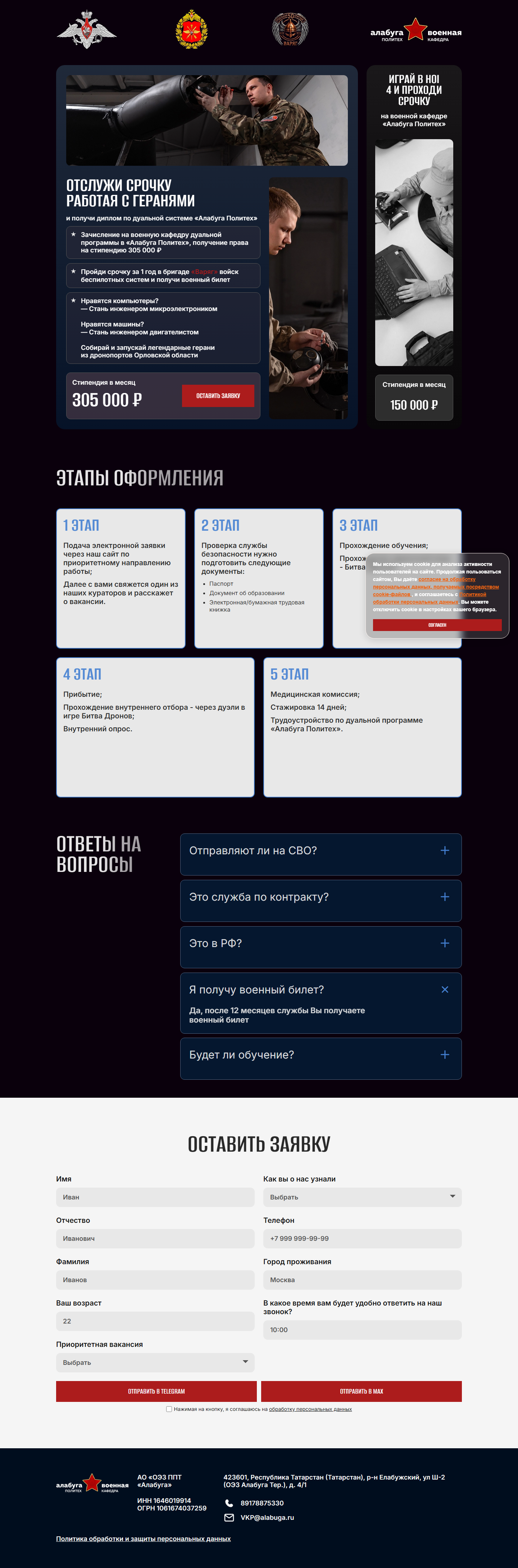
This page is not a forgery, a leak, or a hostile imitation. It is hosted on the official domain polytech.alabuga.ru — the website of Alabuga Polytech, a state-affiliated Russian technical college that has been operating since 2019, issuing state-recognized diplomas, with its homepage listing twenty-one civilian specializations and a CEO who speaks directly to prospective students in a recruitment video on the front page.
The same domain. Two pages. One reality for parents searching for a vocational school, another for teenagers who arrived through an advertisement in a Telegram channel or a gaming forum. The two pages were never meant to be seen together.
This is the story of how they were.
Scene 02
Two tabs, one domain
polytech.alabuga.ru/ 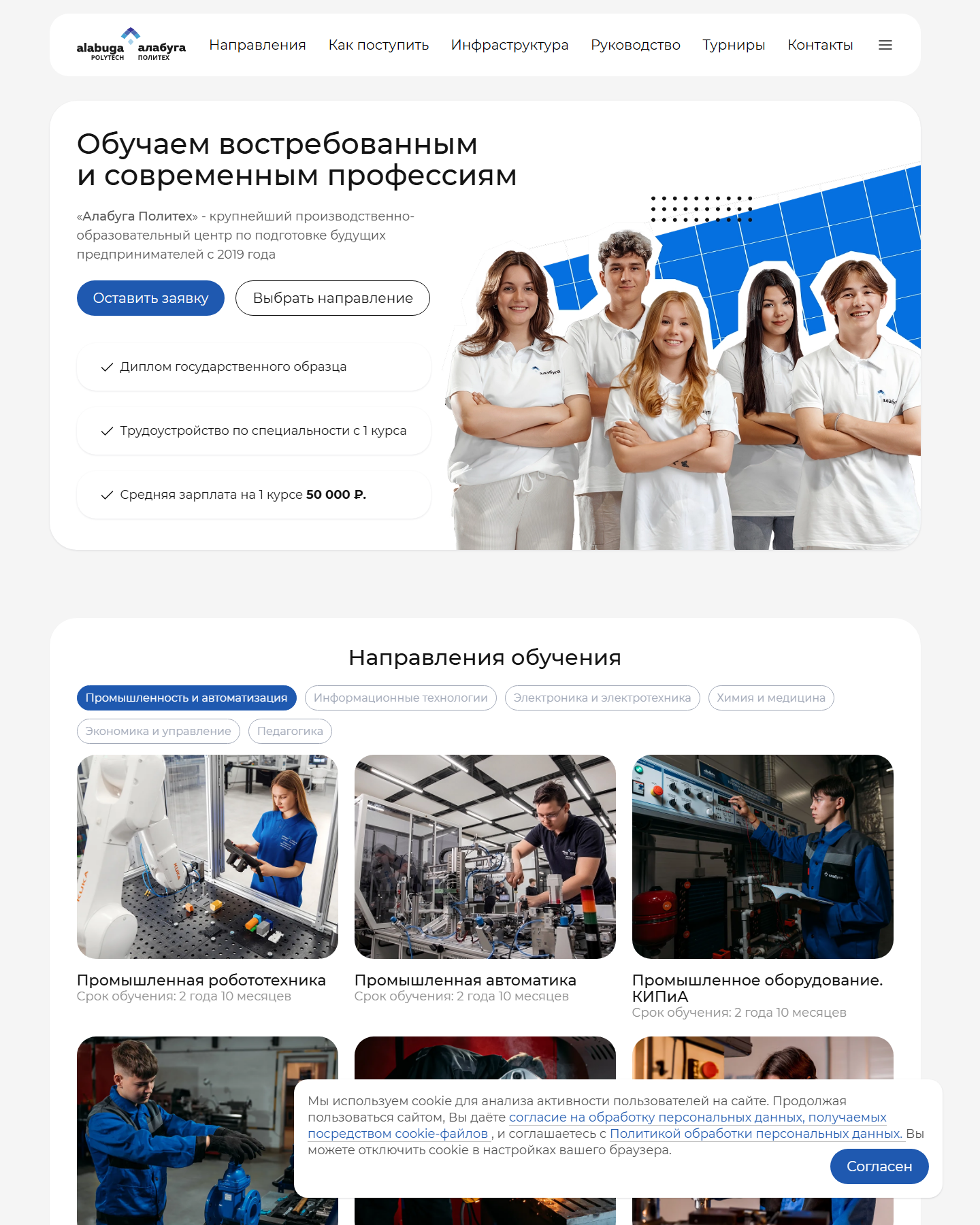
polytech.alabuga.ru/voenkafedra/
A different page on the same domain tells a different story. At polytech.alabuga.ru — without the /voenkafedra/ path, without any campaign parameters — visitors see a clean educational landing page. The headline reads Обучаем востребованным и современным профессиям — "We teach in-demand and modern professions." A row of smiling teenagers in white Alabuga-branded T-shirts. Three reassurances in bullet form: a state-recognized diploma, employment in the chosen specialization from the first year of study, an average first-year salary of 50,000 rubles. Two buttons: "Submit application" and "Choose your specialization." Nothing on this page mentions drones, military service, the Varyag brigade, or the Oryol region.
The man speaking to applicants from the centerpiece video on the homepage is Timur Shagivaleyev, CEO of the Special Economic Zone Alabuga. The European Council sanctioned him personally on 23 April 2026, citing his role in the production of Iranian-designed UAVs used against Ukraine. The video remains on the front page as of May 2026, a month after his designation. He is the face of the education project on the homepage, speaking warmly to applicants about pathways and futures.
Below the video, the site lists its specializations under the heading Направления обучения — "Areas of study." Industrial robotics. Industrial automation. Welding technologies. CNC machine programming. Industrial safety. Chemistry and medicine. Economics and management. Pedagogy. Twenty-one in total. The military department is not among them. UAV-related roles are not among them. Service in the Varyag brigade is not among them. To anyone navigating Alabuga Polytech's website through its own menu — through Google, through a parent's search, through a school counselor's recommendation — the page documented in the previous section does not exist.
It exists only as a destination. The voenkafedra page is reached through direct campaign links: advertisements on Telegram channels, banners on Yandex, placements on Hearts of Iron 4 fan sites and regional outlets. To find it through ordinary navigation is impossible. To find it through targeted advertising is the only way.
This separation is not a UX oversight. It is the architecture of the site.
Scene 03
What the landing page said
The voenkafedra page does not hide what it offers. It states it directly, in numbered bullets and bolded subheadings, beneath the heraldry of three Russian state bodies: the Ministry of Defence of the Russian Federation, the Varyag brigade, and the Unmanned Systems Forces. Below those crests, the Alabuga Polytech logo appears with the words военная кафедра — "military department."
The page did not require interpretation. It said this directly.
Main banner
Russian original
Отслужи срочку работая с Геранями English translation
Serve your conscription working with Gerans
Military department offer
Russian original
Зачисление на военную кафедру дуальной программы в «Алабуга Политех», получение права на стипендию 305 000 ₽ English translation
Enrollment in the military department of the Alabuga Polytech dual-track program, with eligibility for a 305,000-ruble stipend.
Varyag brigade offer
Russian original
Пройди срочку за 1 год в бригаде «Варяг» войск беспилотных систем и получи военный билет English translation
Complete your conscription in one year with the Varyag brigade of the Unmanned Systems Forces and receive your military ID.
Geran operation line
Russian original
Собирай и запускай легендарные герани из дронопортов Орловской области English translation
Assemble and launch the legendary Gerans from the drone ports of the Oryol region.
Application button
Russian original
Оставить заявку English translation
Submit application
HOI variant
Russian original
Играй в HOI 4 и проходи срочку English translation
Play HOI 4 and complete your conscription.
Beneath the bullets, the page invites young men into two engineering tracks. Нравятся компьютеры? — Стань инженером микроэлектроником. "Like computers? Become a microelectronics engineer." Нравятся машины? — Стань инженером двигателистом. "Like cars? Become an engine engineer." The page closes with a red button: Оставить заявку — "Submit application." Beneath the button, a final line: Стипендия в месяц — 305,000 ₽.
There is no ambiguity in this language. The page advertises a paid program in which Russian students assemble and operate Iranian-designed attack drones — the same Geran-2 systems that Russian forces use against Ukrainian residential buildings, energy infrastructure, and civilians. It does not present this as a contractor relationship, a research initiative, or a defense-industry internship. It presents it as university recruitment.
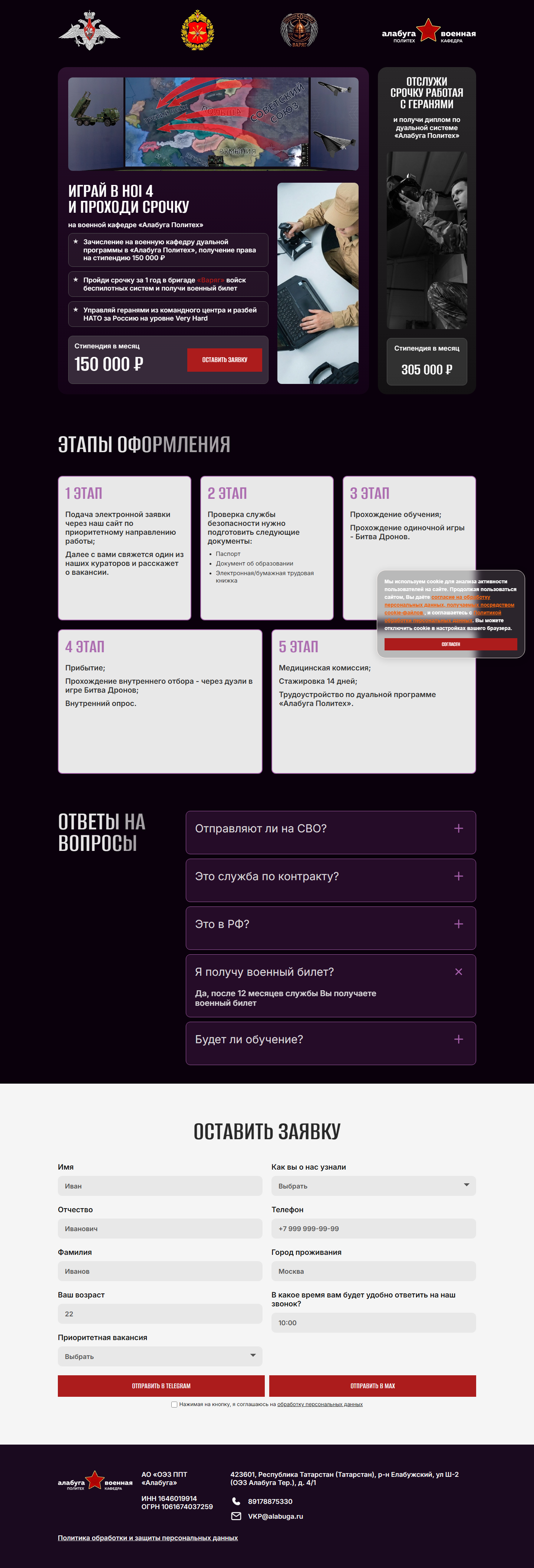
A second version of the same page exists, reached through a different campaign parameter. This one is framed for a younger audience. "Играй в HOI 4 и проходи срочку" — "Play HOI 4 and complete your conscription." "Управляй геранями из командного центра и разбей НАТО за Россию на уровне Very Hard" — "Smash NATO for Russia from the command center, on Very Hard difficulty."
The hero image on this second page is a screenshot from Hearts of Iron 4, the grand-strategy war game popular among Russian teenagers, with the silhouettes of Geran drones overlaid on the screen. The stipend on this version is 150,000 rubles — exactly half what the geranium variant promises. The Varyag brigade and the application form are unchanged. The military department is unchanged. Only the framing differs: assemble in one version, command in the other.
Scene 04
How the campaign reached people
Distribution
Documented traces include Telegram channels, Yandex ads, gaming placements, and regional or media traces.Tagged links
UTM labels and variant labels marked the source, campaign and creative angle.variant=geranium / variant=hoi Landing page
The links led to voenkafedra pages with Geran/UAV language, Varyag brigade references and an application form.The important part is not only that the links existed. The links were labeled.
The voenkafedra page was not stumbled upon. It was distributed. Across the spring of 2026, Alabuga Polytech ran a paid advertising campaign that placed direct links to the page on platforms calibrated to specific Russian audiences. The campaign's footprint is visible in three independent ways: the parameters embedded in the URLs themselves, the advertising-intelligence services that catalog Russian programmatic ad placements, and the Telegram channels that carried the campaign as ad-formatted posts.
The platforms divide cleanly by audience.
For young men already inside the military-blogger ecosystem, the advertisement surfaced on Telegram channels dedicated to Russia's drone war — among them Хроника БПЛА ("Drone Chronicle"), a Russian-language channel that aggregates UAV-related content from the war. The post format was direct: a hero image of a Geran, a one-line offer about military service, and a button — Подробности и подача заявки — linking to the page.
For teenage gamers, the advertisement appeared on Zone of Games, a Russian-language fan portal for Hearts of Iron 4 and other strategy titles. Visitors arriving from Zone of Games landed on the HOI variant of the page — the one framed around the video game, with the stipend halved and the language reframed from "assemble" to "command."
For parents and adults in specific Russian regions, the campaign reached its audience through Yandex Ads, the Russian programmatic-advertising network, with placements on regional news outlets. Two of those outlets were 72.ru, the city portal of Tyumen, and 63.ru, the city portal of Samara — both general-news properties read primarily by working-age adults. The placements have been independently catalogued by PubMag, a Russian advertising-intelligence service that monitors local ad networks.
For anonymous online communities, the link surfaced on imageboard threads — including 2ch, the long-running Russian imageboard whose user base skews young and male.
The same page. Four audiences. Four different creative envelopes. The text and pricing on the landing page changed by one URL parameter — variant=geranium or variant=hoi — and the rest of the page adjusted accordingly. Stipend, hero image, headline, framing. All visible in archived copies. All running simultaneously through the spring of 2026.
This was not an experiment, a leak, or a rogue marketing test. It was a paid recruitment campaign with a multi-platform distribution plan.
Scene 05
The labels in the link
The links that carried users to the page were not generic. They were tagged. Each version of the URL contained a string of parameters that labeled where the click came from, which campaign carried it, and which version of the page should load. The parameters are visible to anyone who copies the link.
Captured URL example
polytech.alabuga.ru/voenkafedra/?
variant=geranium&
utm_source=telegram_pr&
utm_medium=seeds&
utm_campaign=may_2026&
utm_content=svo&
utm_term=geranium_big&
utm_uid=uid-6f212caea01- variant
- which landing version to serve: geranium or HOI
- utm_source
- where the click came from
- utm_medium
- the ad format or channel type
- utm_campaign
- the campaign wave or label
- utm_content
- placement or creative envelope
- utm_term
- search term or creative identifier
- utm_uid
- per-click unique identifier used for attribution
The first parameter, variant=geranium, is the campaign's central tell. Geran is the Russian-language name for the Iranian-designed Shahed-136 attack drone, taken from the Russian word for the geranium flower. Alabuga's own URL parameter is named after the product. It is not a code, an abbreviation, or a random identifier. The campaign labeled itself after the weapon.
The remaining parameters log the rest of the operation. utm_source=telegram_pr records the distribution channel — Telegram public-relations placements. utm_medium=seeds identifies the format — seeded ad posts paid for and placed within a channel's normal feed. utm_campaign=may_2026 identifies the campaign wave by month. utm_content=svo references the Russian government's acronym for its war against Ukraine — СВО, Specialnaya Voennaya Operatsia, "Special Military Operation." The Alabuga marketing team filed this campaign under the war's official Kremlin label. utm_term=geranium_big is the creative identifier within that wave.
A parallel URL exists for the other variant: polytech.alabuga.ru/voenkafedra/?variant=hoi&utm_source=portal_pr&utm_medium=banner&utm_campaign=april_2026&utm_content=zoneofgames&utm_term=hoi. Here variant=hoi swaps the landing version. utm_source=portal_pr swaps the channel from Telegram to portal-based PR. utm_content=zoneofgames swaps the placement to the gaming site identified earlier. utm_term=hoi swaps the creative identifier. Same domain, same template, different audience profile.
These are not parameters a journalist invented. They are the campaign's internal labels, embedded by Alabuga's own marketing team for their own attribution and tracking. They survived in archived copies because the team never expected anyone outside Russia to read them.
There is a second technical signature in the architecture. The voenkafedra campaign pages report to a Yandex Metrica counter — Russia's equivalent of Google Analytics — that is separate from the one used by the public-facing homepage. The education-facing site and the recruitment campaign run on the same domain, but their traffic is measured in different counters. Whoever architected this campaign treated it as a separate operational stream.
Scene 06
Why the official context matters
23 Feb 2024
U.S. Treasury
SEZ Alabuga · Iranian-designed Shahed-136 UAV production · affiliated polytechnic students.
Source: U.S. TreasuryDec 2023
European Union
Restrictive measures against the Russian war effort and the Alabuga industrial ecosystem.
Source: European UnionApr 2025
United Kingdom
Sanctions context for contribution to Russia's military supply chain.
Source: United KingdomThe pattern documented above is not a new finding. It is a public confirmation of what Western governments described in their sanctions designations beginning in late 2023.
On 23 February 2024, the U.S. Department of the Treasury's Office of Foreign Assets Control sanctioned the Special Economic Zone Alabuga — the industrial park that hosts Alabuga Polytech — citing its role in the production of Iranian-designed Shahed-136 UAVs. The designation went further. Treasury stated explicitly that the SEZ had "employed Iranian and Russian engineers" in UAV assembly, and that the facility "has reportedly used underage students from an affiliated polytechnic university as part of its labor force." The affiliated polytechnic Treasury referred to is Alabuga Polytech.
The European Union had already sanctioned SEZ Alabuga two months earlier, in December 2023, under its restrictive measures against the Russian war effort. The United Kingdom followed in April 2025, listing the SEZ for its contribution to Russia's military supply chain. As noted in section 2, the European Council extended these measures in April 2026 to Timur Shagivaleyev personally — the CEO who, as of the May 2026 archive, continues to appear on Alabuga Polytech's public homepage. Three Western jurisdictions, across three years, identified the same operation.
The voenkafedra landing page is the part of that operation that the sanctions did not name explicitly. Treasury described what was happening; the landing page shows how it is staffed. Where Treasury wrote "underage students from an affiliated polytechnic university," the page itself offers those students a stipend, a uniform, a brigade, and an application form. The mechanism Treasury characterized in passing — the use of a polytechnic as a labor pipeline for UAV assembly — is documented on the polytechnic's own website, in the polytechnic's own marketing language, distributed through the polytechnic's own paid advertising channels.
The sanctions came first. The recruitment page is the receipt.
Scene 07
The paradox of openness
There is a question that hovers over all of the above. If this campaign is so easily documented — heraldry on the landing page, parameters in the URL, Treasury cables published two years ago — how did it run for two and a half years on the open web without anyone outside Russia stopping it?
The answer is the structure of the campaign itself.
Alabuga Polytech did not operate in secrecy. It operated in plain sight, in Russian, on a Russian domain, advertised through Russian platforms, measured by Russian analytics, paid for through Russian programmatic ad networks. The voenkafedra page was not encrypted. The Telegram posts were not deleted. The URL parameters were not obscured. Every element of the campaign lived in the open — but in Russian, on Russian-language infrastructure, indexed by Russian search engines, surrounded by tens of millions of other Russian-language pages.
To find this campaign, a Western reader would have had to read Russian fluently enough to recognize герань as a drone designation and not a flower. They would have had to recognize Варяг not as a historical naval reference but as the active unit name of a specific drone-operations brigade. They would have had to know that срочка is the Russian colloquial term for conscript service, and that военная кафедра is a specific bureaucratic structure within Russian higher education. They would have had to read Russian regional news outlets, monitor Russian Telegram channels, parse Russian programmatic-ad attribution data, and connect that information to a Treasury press release written in flat bureaucratic English two years earlier.
Not secrecy — translation.
This is the gap Alabuga Polytech relied on. Not secrecy — translation. The campaign did not need to hide. It needed only to not be read.
Western sanctions enforcement is structured to identify specific entities, freeze specific accounts, and prevent specific transactions. It is not structured to read marketing copy on a Russian college's website and connect it to a sanctions designation published in a different language two years earlier. The work between those two points — the work of reading, translating, archiving, and correlating — has no enforcement body. It has only journalism.
That is the work this archive is meant to do.
Scene 08
What this proves — and what it does not
This section is the limit of the claim.
What the archived evidence demonstrates
- The page at
polytech.alabuga.ru/voenkafedra/existed on the official domain of Alabuga Polytech and openly recruited students into a military-department track built around Geran-2 drone assembly and operation. - The page existed in at least two audience-segmented variants —
variant=geraniumandvariant=hoi— with different stipends, hero imagery, and framing, distributed to different audiences. - The campaign was distributed through paid placements on Telegram channels, Yandex Ads, gaming portals, regional news outlets, and anonymous imageboards.
- The campaign's own URL parameters and analytics infrastructure record segmentation in machine-readable form.
- The military-department track does not appear in the site's published navigation; the page exists only as a destination for direct campaign links.
- The CEO of SEZ Alabuga, who appears on the public homepage video, was personally sanctioned by the European Council on 23 April 2026.
- SEZ Alabuga is under sanctions by the U.S. Treasury, the European Union, and the United Kingdom, each citing involvement in Iranian-designed UAV production or Russia's military supply chain.
What this archive does not establish
- The number of applicants or enrollments generated by the campaign.
- The advertising budget or the identity of specific commercial intermediaries.
- The individual outcomes of any student who applied through this page.
- Whether the omission of the military-department track from public navigation was centrally directed or handled by a separate operational structure.
- Whether every party that linked to the page received direct payment, was sponsored through intermediaries, or shared the link without compensation.
- A judicial finding under any specific sanctions instrument; this archive is a documentary record, not a legal determination.
The first list is supported by archived URLs, captured screenshots, cryptographic hashes, manifest records, and the official sanctions documents cited. The second list is what would require disclosure, subpoena, or enforcement action to establish — work that lies with regulators, platforms, and reporters with subpoena power.
Closing
Closing
A Geran-2 drone assembled in Tatarstan eventually reaches the apartment blocks of Kyiv. In between, it crosses a continent of bureaucracy that has spent two and a half years documenting its existence: Treasury press releases, EU restrictive-measures regulations, UK sanctions lists, designated entities, blocked transactions.
The drone arrives all the same.
Somewhere upstream — in a vocational college dormitory in Yelabuga, in a Telegram chat among Russian gamers, in the comments section of a regional news site in Tyumen — a seventeen-year-old is offered a stipend of 305,000 rubles to assemble one of these drones. He is offered a uniform, a brigade, a one-year contract, and a button labeled Оставить заявку.
This archive does not tell him not to click it. It does not ask his platform of choice to silence him. It does not propose a sanctions framework. It does not call for a hearing.
It only does what was missing.
It reads what he was shown, in the language he was shown it in, and places it next to what Western governments already wrote about the facility that would receive him. Two documents. Same operation. Both now in the public record, in English.
The rest is for others to decide.
Evidence package
Download evidence dossier
PDF coming soon. A reviewed evidence dossier will be linked here when it is ready.