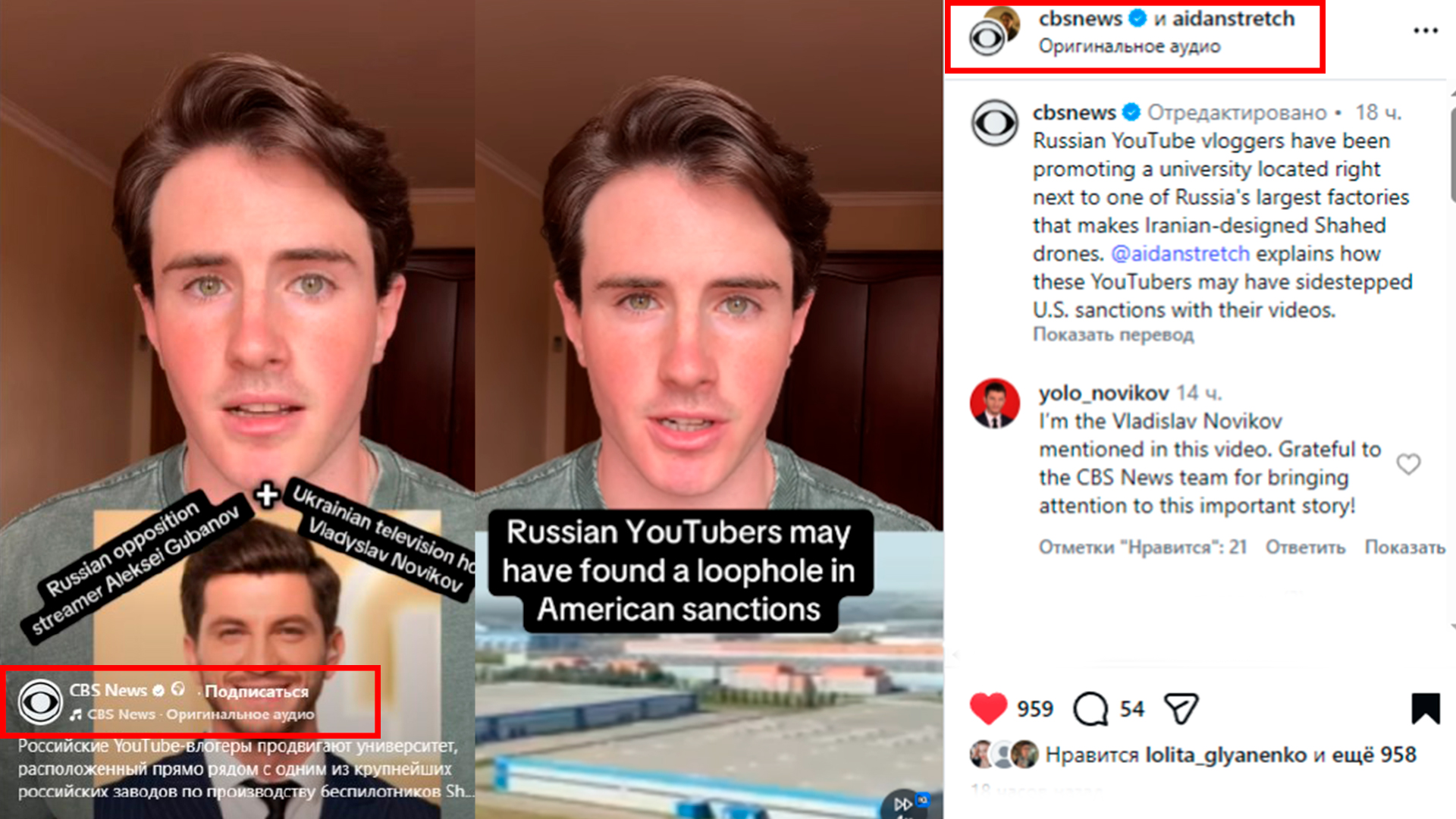
CBS News has covered the sanctions gap around Alabuga Polytech and cited the Alabuga Evidence Archive, assembled by Ukrainian journalist Vladislav Novikov together with blogger Alexei Gubanov (JesusAVGN). The segment opened on a single line:
"Russian YouTubers may have found a loophole in American sanctions."
The loophole is not complicated. The Alabuga Special Economic Zone produces Iranian-designed Shahed attack drones — the "Geran" systems Russia launches at Ukrainian cities. The zone is sanctioned by the United States, the European Union and the United Kingdom. CBS reported that the U.S. Treasury has warned the university "works as a pipeline, recruiting the students to the drone factory next door." Yet Alabuga Polytech, the youth-facing recruitment and education layer, is not itself named on the U.S. sanctions list. As CBS put it, the factory is sanctioned; the university next door is not — so, technically, the creators who promoted it may not have broken any law or platform rule.
That technicality is the entire story.
While drones from Alabuga were killing civilians, the complex that builds them was being marketed to young Russians on a U.S. platform as a career opportunity — through hundreds of Russian-language influencer videos, including gaming channels with audiences in the millions. The promotion ran from 2022 through 2026. It continued after OFAC sanctioned the zone in February 2024. It continued after the EU expanded its measures in October 2025. It only began to disappear after the April 2026 Twitch bans, when creators understood the risk had become real and started deleting and editing videos.
This archive preserved that record first.
Every platform but one
The pattern of platform response is now visible. In April 2026, Twitch banned the streamers who broadcast an Alabuga-linked tournament. In May 2026, TikTok removed creators who had promoted Alabuga Polytech — in at least two separate waves, some with millions of followers. YouTube, where the largest body of promotional content lived, has not acted.
The question CBS raised is the one that remains open: if the drone-production ecosystem is sanctioned, why does the recruitment layer that feeds it still sit outside direct designation — and how long does the largest platform that carried its promotion stay silent?
What the archive holds
CBS News reported that, after Ukrainian television host Vladislav Novikov and Russian opposition streamer Alexei Gubanov began documenting the videos, many of them started disappearing — and that the two "created an archive tracking the deleted material." This is that archive.
The evidence was frozen before it vanished: 606 collected URLs, 527 locally archived videos, 448 structured evidence cases across 320 channels. Each case carries metadata, subtitles, timecodes, quotes, screenshots and SHA-256 hashes for chain of custody. Seventy-nine videos were already deleted, private or removed by the time they were checked — preserved here regardless.
What needs to change
CBS closed its segment by noting that Novikov believes this should change. The change is concrete: the recruitment layer that feeds a sanctioned production complex belongs inside the same designation, and the platform rules that already exist should be applied to the channels that promoted it.
Watch the CBS News segment: Instagram · TikTok · Facebook.
Browse the evidence: alabugacase.org.
A structured evidence record for review — not a legal finding or a determination of guilt.
About the author
Vladislav Novikov (also transliterated Vladyslav Novikov) is a Ukrainian journalist and television host at 24 Kanal. He compiled, structured and signed this evidence archive.
Profiles and coverage: 24 Kanal · 24 Kanal — author archive · Instagram · YouTube — Novi TV · YouTube — playlist